

I went to a conference in San Francisco… and on that day, I saw more vibe-coded sites and apps than across my entire LIFE.
There are two lenses I would view this from:
First: Hey, it’s great people are solving problems are left and right.
Second:

To be more dramatic, it felt damaging to the soul.
Now that there is a new tool available, execution is easier and faster, but not necessarily better.
But reality is, no one became a painter just by holding a paintbrush, you didn’t become a musician just because you bought a guitar. You have to put in the work.

There are two things I keep in mind when working with Generative AI, from documents to software:
First: AI generates toward the average.
This is how AI models are designed work. A model trained on the internet learns the patterns of the internet. This is beneficial for AI models used in predicting and forecasting, but it is what holds back Generative AI from being great.
When you ask a large language model to generate anything, it gives you the most common pattern. When the average gets prettier, it’s still…. the average.
So the discipline is to give the model a stronger context than the average. Your voice, your principles, the things you would and wouldn’t say or do. For a brand, this means extracting and articulating what makes the work recognizable as yours. For a designer, it’s maintaining a design library it can draw from. Generative AI, or any AI model for that matter, is an algorithm after all.
This is where design systems come in, brand book, SOPs, etc. And it’s important you pour yourself into them. Which brings me to the second reason…
Second: AI can generate, but it cannot create.
As algorithms, models can generate, expand, rewrite, and rephrase endlessly. What they can’t do is come up with something new. Creation requires stakes… taking a risk by going beyond the status quo, having a vision not everyone has thought of. AI has none of these. It doesn’t care which draft you pick, and it would happily produce a thousand more.
This is why the best use case for Generative AI is on businesses, not on the arts. AI models can take over so much of the repetitive work because of its nature (and yes, businesses still requires creativity).
So does feeding context fix the slop? Yes and no. Once you feed your context to a language model, it generates your average work. This can work for a bit… but your work is the worst its ever going to be (which I hope you find inspiring).
The discipline is to keep the judgment with you. Don’t outsource the understanding and the caring. The moment you stop choosing, the moment you ship what the model gave you as it is, slop comes back.
The best products are made by people who put a piece of themselves into the work.
The worst products feel soulless. You can sense when nobody cares. Most enterprise software feels this way.
AI has made it super easy to create soulless things at scale. But it doesn’t have to be this way. The antidote is to be even more intentional about creating things with soul.
— Amir Salihefendic
Context in, judgment out.
A model with full context but no judgment still ships generic; a judging human without the right context feeds in junk and gets junk back. The work is both in context & judgement, every time.
It’s a discipline. You don’t deslop once and stay deslopped. The context decays & the judgment wavers. The work to put in is the repeated refusal of the default.
In a sense, every engineer needs to start pouring their soul like an artist. Maybe that is all job that there will be.
To take a page off an artistic movie:
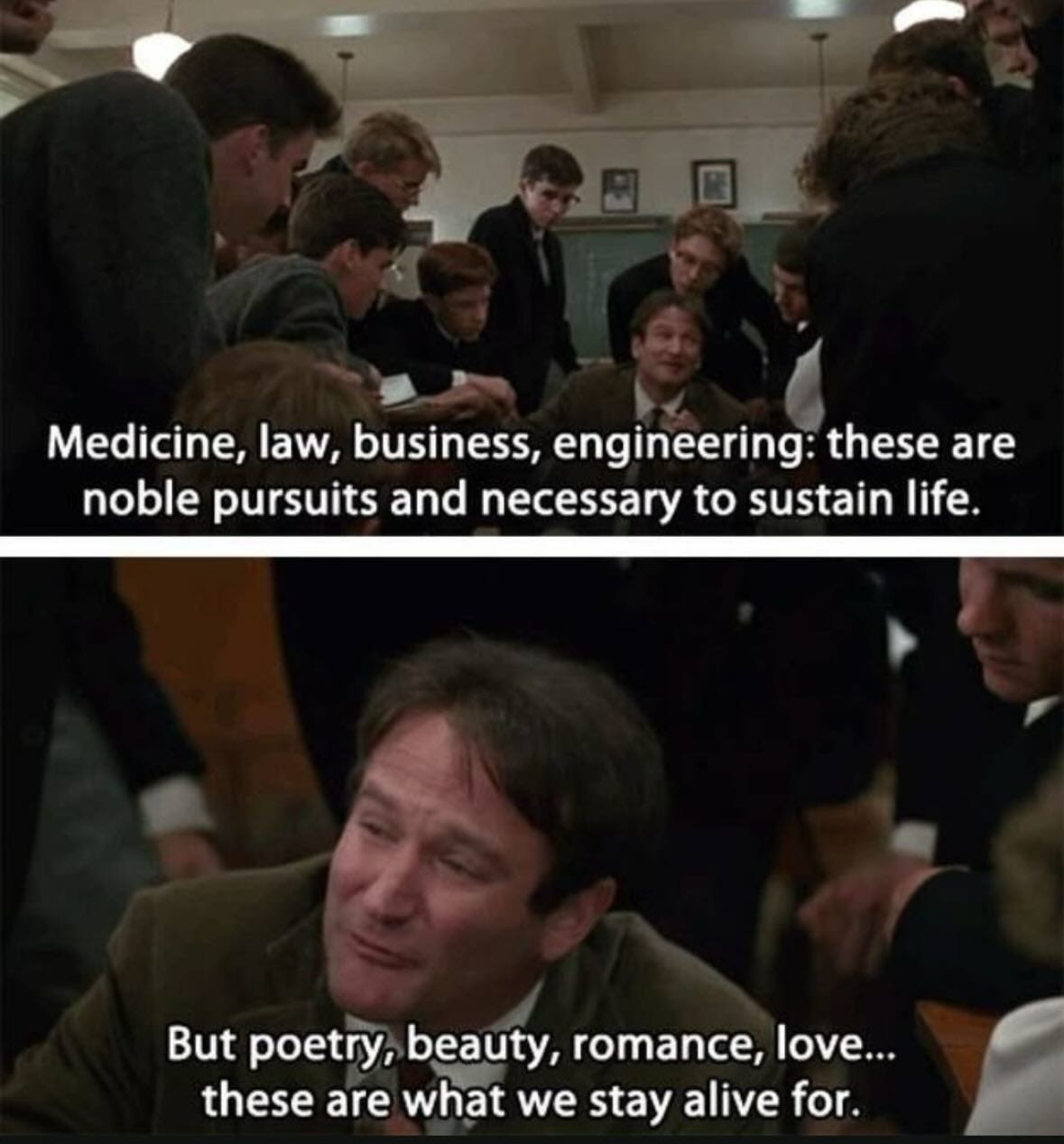
Slop hurts to look at because it’s what we become when we stop showing up. With generative AI, it is easier to not show up anymore.
AI will always produce slop. That’s not a question. The question is whether you will.